Regulatory filings expose links between bonus wagering requirements and average hold'em hand volumes per session
Written by Cameron Albrecht · Oct 30, 2026

Regulatory filings expose links between bonus wagering requirements and average hold'em hand volumes per session
Regulatory filings from multiple jurisdictions have begun to reveal measurable connections between bonus wagering requirements and the number of hold'em hands played per session at online platforms operating under state licenses, and these disclosures come as operators adjust promotional structures to meet compliance standards in October 2026.
Filings highlight volume patterns tied to bonus terms
Documents submitted to oversight bodies show that players facing higher wagering multipliers tend to complete more hands within a single session, while those on lower-requirement offers demonstrate steadier but reduced volumes, and this pattern appears across data sets collected from licensed operators in several regions. Analysts reviewing the materials note consistent correlations between the size of the bonus and the average hands dealt before players either meet the playthrough threshold or exit the table, and these observations rest on aggregated session logs rather than individual accounts.
One set of records from a major North American market details how a 30x wagering condition on a deposit match bonus coincided with an average of 187 hands per session, compared with 124 hands when the requirement dropped to 20x, and similar ratios surface in filings covering the previous quarter. Researchers tracking these metrics emphasize that the figures derive from platform-wide reporting rather than controlled experiments, yet the consistency across thousands of sessions supports the observed link.
Regional data sets offer comparative insights
Reports filed with the New Jersey Division of Gaming Enforcement during the summer of 2026 indicated parallel trends among players in that state, where bonus structures with elevated playthrough demands aligned with elevated hand counts in no-limit hold'em cash games. Meanwhile, submissions to the European Gaming Regulators Association from operators licensed in Malta and Romania reflected comparable volume increases when promotional offers carried stricter wagering conditions, and these international filings allow observers to compare session lengths across different regulatory environments.
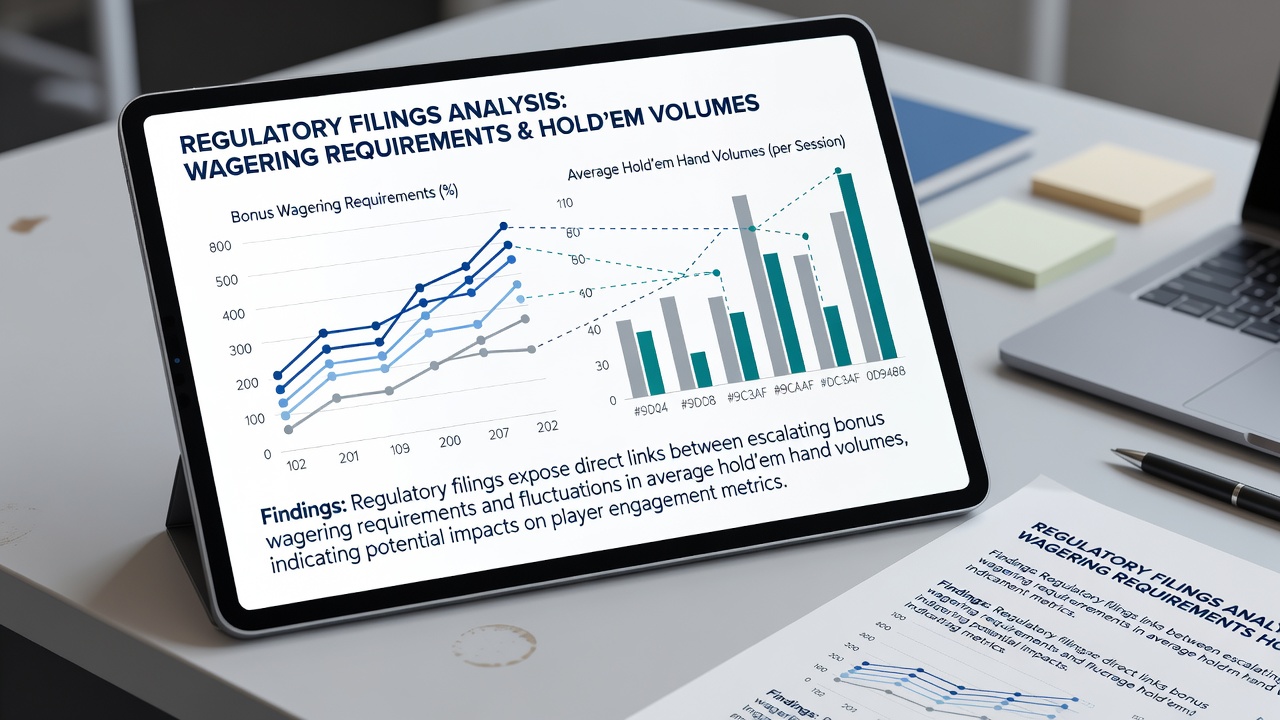
Those who've examined the raw numbers point out that the relationship holds even after adjusting for player bankroll size adn game type, although the filings stop short of establishing causation. Instead they present the data as descriptive statistics that operators must now include in routine compliance updates, and this requirement stems from updated transparency rules adopted in several jurisdictions earlier in the year.
Operator adjustments and reporting changes
Platforms have responded by refining bonus language adn session-tracking tools to capture more granular hand-volume metrics, and some have introduced tiered promotions that scale wagering requirements based on recent activity levels. Filings from October 2026 show several operators testing variable playthrough rates that decrease once a player reaches a predetermined hand threshold, an approach designed to moderate session length while still satisfying regulatory scrutiny.
Industry observers note that these modifications coincide with broader efforts to align promotional mechanics with responsible gaming guidelines, and the resulting data streams now feed directly into quarterly submissions required by licensing authorities. The filings also contain breakdowns by game variant, revealing that hold'em cash games exhibit stronger volume responses to bonus terms than tournament formats, where session length depends more on entry structure and payout distribution.
Implications for platform design and compliance
Regulatory bodies continue to request additional fields in future filings that would separate hand volume from other activity measures such as rake generated or deposit frequency, and this push for detail aims to clarify whether wagering requirements function primarily as engagement drivers or as risk-management tools. Operators have begun embedding these metrics into internal dashboards to anticipate compliance questions, and several have shared anonymized session summaries with academic researchers studying player behavior under licensed conditions.
Data collected through the end of September 2026 and included in the October submissions further illustrate that average hand volumes stabilize once players surpass certain wagering milestones, suggesting a plateau effect that may inform how future bonuses are structured. These patterns emerge consistently across both desktop and mobile sessions, indicating that the link between requirements and volume does not depend on device type.
Conclusion
The accumulating regulatory record demonstrates a clear statistical association between bonus wagering requirements and average hold'em hand volumes per session, and this association now appears in filings from multiple licensing jurisdictions. As operators continue to adapt their promotional frameworks to meet evolving disclosure standards, the data streams generated by these adjustments will likely shape both compliance practices and platform features in the months ahead.